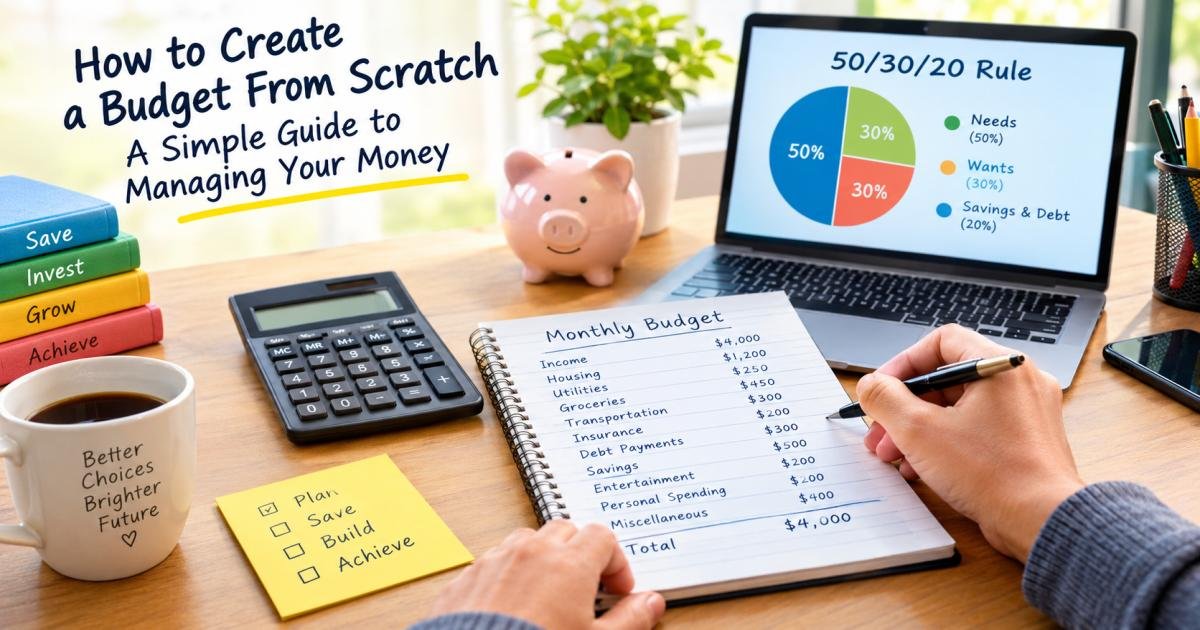
How to Create a Budget From Scratch: A Simple Guide to Managing Your Money
You get paid on Friday. By the next Thursday, the money is gone, and you can’t say where it went. That is the most common money problem there is, and it has a simple fix.
This guide shows you how to create a budget, even if you have never made one. You will learn how to make a monthly budget in eight steps, see a full example with real numbers, and learn the 50/30/20 rule. You will also find help for uneven pay, debt, and surprise bills.
A note on trust: this guide is general education, not personal financial advice. The figures come from public sources like the Federal Reserve, the Consumer Financial Protection Bureau (CFPB), and the USDA. Check current numbers for your country and your tax rules. If you carry heavy debt or run a business, a fee-only financial planner or a nonprofit credit counselor can review your case.
What Is a Budget and Why Does It Matter?
A budget is a written plan that shows how much money comes in each month and where it will go. You make it before you spend, not after.
That order is the point. Looking back at your bank app tells you what happened. A budget tells your money what to do next.
Here is why it matters:
- It shows real numbers. Most people guess their spending and guess low. A budget replaces guesses with facts.
- It protects you from small shocks. In the Federal Reserve’s yearly survey of U.S. households, about six in ten adults say they could pay a $400 emergency with cash. That leaves roughly four in ten who would borrow, sell something, or go without.
- It gives you a path to goals. A home deposit, a trip, or a debt-free date all need a monthly number.
- It lowers stress. Knowing the bills are covered makes it easier to spend the rest without guilt.
A budget is not a punishment. A good one has room for fun, because plans that feel harsh usually fall apart within weeks.
How to Create a Budget From Scratch
Follow these eight steps in order the first time. After that, you can jump to whichever step you need.
1. Calculate Your Monthly Take-Home Income
Start with take-home pay. This is the money that reaches your bank account after taxes, insurance, and retirement deductions. Your pay stub lists it as net pay.
Add up every source of regular income:
- Paychecks (net amount)
- Side jobs or gig work
- Benefits, such as Social Security or disability
- Child support or alimony you receive
- Rental income
If you get paid every two weeks, you will see two months a year with three paychecks. Build your budget on two checks per month. Put the extra check toward savings or debt.
Write down one number. That is your monthly income, and every other step depends on it.
2. Track Your Spending
Next, find out where your money actually goes. Open your bank and card statements for the last two or three months. Go line by line and tag each charge: rent, groceries, gas, fun, and so on.
Don’t judge what you see. Just collect facts.
A few tips:
- Watch for small repeat charges. Coffee runs and delivery fees add up quickly.
- Hunt for old subscriptions. Most people find at least one they forgot.
- Count cash spending. If you use cash, keep receipts for a few weeks.
- Include yearly bills, like car registration or annual software fees.
This step often gives the fastest win. Canceling a service you never use costs you nothing and frees money right away.
3. Separate Needs, Wants, Savings, and Debt
Sort your spending into four groups.
Needs are costs you must pay to live and work. Examples: rent, basic groceries, utilities, insurance, transport to work, and minimum debt payments.
Wants make life nicer but are not required. Examples: dining out, streaming, hobbies, new clothes, and trips.
Savings is money you set aside for later. Examples: an emergency fund, a home deposit, and retirement.
Debt repayment is any payment above the minimum on credit cards, student loans, or car loans.
Some items sit in a gray zone. Groceries are a need, but steak every night is a want. A phone is a need, but the newest model is a want. Be honest here. This step is where you find room to move.
4. List Your Fixed and Variable Expenses
Now sort costs a second way: by how much they change.
Fixed expenses stay the same each month. Rent, insurance, and loan payments fit here.
Variable expenses change. Groceries, gas, electricity, and dining out fit here.
Fixed costs are hard to change fast. Variable costs are where you have the most control, so that is usually where you cut first. For variable costs, use the average of the last three months. If your electric bill was $90, $110, and $130, plan for $110.
5. Set Short-Term and Long-Term Financial Goals
A budget without a goal is hard to keep. A goal gives you a reason to say no to small things.
Pick two or three goals. Give each a dollar amount and a date.
- Short-term (under 1 year): Save a $1,000 starter emergency fund. Pay off a $600 credit card balance.
- Medium-term (1 to 5 years): Save $8,000 for a car or home deposit.
- Long-term (5+ years): Build retirement savings or a college fund.
To find your monthly target, divide the goal by the number of months. To save $1,200 in 12 months, set aside $100 each month.
Most financial educators suggest a small starter fund first, then a full fund of three to six months of basic costs. Even $500 can stop a car repair from turning into credit card debt.
6. Choose a Budgeting Method
No single method wins. The best one is the one you will use. Here are four common choices.
50/30/20 rule. Split take-home pay into 50% needs, 30% wants, and 20% savings and debt. It is the easiest place to start for a budget for beginners.
Zero-based budget. Give every dollar a job until income minus planned spending equals zero. Savings counts as a job. This suits people who like detail.
Envelope method. Put cash for each variable category in an envelope. When it’s empty, you stop spending in that category. Many apps offer a digital version.
Pay yourself first. Move money to savings on payday, then spend what is left. It takes almost no effort to maintain.
If you are new, try 50/30/20 first. You can switch later.
7. Create Your First Monthly Budget
Now build it. Use a spreadsheet, a notebook, or an app.
- Write your monthly income at the top.
- List fixed expenses with their amounts.
- Add variable expenses, using your three-month averages.
- Add savings goals and extra debt payments.
- Subtract total spending from income.
If the result is zero or slightly positive, you’re set. If it’s negative, you plan to spend more than you earn, so move to step 8.
Round your costs up a little. Ending a month $50 ahead feels much better than ending it $50 short.
8. Adjust the Numbers Until Your Budget Is Realistic
Your first draft will miss the mark somewhere. That is normal.
If the numbers don’t add up, you have three options:
- Cut costs. Trim wants first. Cancel unused subscriptions, cook at home more, and compare prices on insurance and phone plans.
- Raise income. Take extra shifts, freelance, sell things you no longer use, or ask for a raise.
- Do both. Small cuts plus a little more income often work best.
Don’t squeeze every category to zero. A budget with no fun money usually breaks by month two. Make it livable, then tighten it slowly.
A Simple Budget Example for Beginners
Numbers make the steps clear. Here is one sample. Yours will differ, and that is fine.
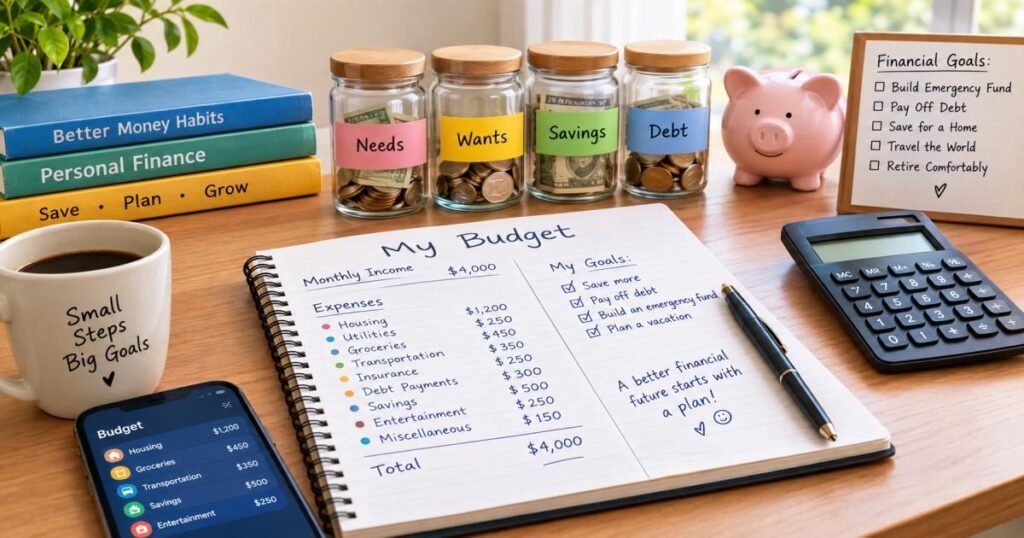
Example Monthly Budget on a $4,000 Take-Home Income
| Category | Type | Monthly Amount |
| Rent | Need | $1,200 |
| Utilities | Need | $150 |
| Groceries | Need | $400 |
| Transport (gas, bus, upkeep) | Need | $250 |
| Insurance | Need | $100 |
| Phone and internet | Need | $100 |
| Total needs | $2,200 (55%) | |
| Dining out | Want | $250 |
| Subscriptions | Want | $50 |
| Shopping and clothes | Want | $150 |
| Entertainment and hobbies | Want | $200 |
| Gifts and personal care | Want | $250 |
| Total wants | $900 (22.5%) | |
| Emergency fund | Savings | $300 |
| Retirement or other savings | Savings | $200 |
| Extra debt payment | Debt | $400 |
| Total savings and debt | $900 (22.5%) | |
| Total | $4,000 |
Needs run a bit above 50%, which is typical in cities with high rent. Wants come in under 30% to make up for it. Savings and debt land above 20%, which speeds up progress. The rule is a guide. What matters is that income minus spending equals zero, and every dollar has a job.
How the 50/30/20 Budget Rule Works
Elizabeth Warren and her daughter, Amelia Warren Tyagi, popularized this rule in their 2005 book All Your Worth. It is popular because you only track three groups.
50% for Needs
Half of your take-home pay covers costs you can’t skip: housing, groceries, utilities, insurance, transport, and minimum debt payments. On $4,000, that is $2,000.
Many households in expensive cities spend more than half on needs. If that’s you, work on fixed costs over time. A roommate, a cheaper phone plan, or a shorter commute can each free up real money.
30% for Wants
Wants get 30%. That covers dining out, shopping, hobbies, trips, and streaming. On $4,000, that is $1,200.
Wants are not the enemy. Spend on them on purpose, not by habit. Before a purchase, ask: “Will I still enjoy this next month?” If not, skip it.
20% for Savings and Debt Repayment
The last 20% builds your future. It covers emergency savings, retirement, and debt payments above the minimum. On $4,000, that is $800.
If your employer matches 401(k) contributions, try to get the full match. It is free money. Count those payroll deductions toward your 20%.
When the 50/30/20 Rule May Not Fit Your Situation
The rule is a starting point. It may not fit if:
- You live in a high-cost area. Rent alone can take 40% or more of your pay.
- Your income is low. Needs may take 70% or more, leaving less for the other two groups.
- You carry heavy debt. You may want to send 30% or more to debt for a while.
- Your income is high. You may be able to save 40% or more.
- You’re chasing a big goal. A home deposit may call for a larger savings share.
If the rule doesn’t fit, change the split. A custom plan you follow beats a textbook plan you ignore.
How to Budget With an Irregular Income
Freelancers, gig workers, seasonal workers, and business owners face a harder version of this problem. Pay swings from month to month, but you can still plan.
- Find your baseline. Review 6 to 12 months of income. Note your lowest month, or use a safe average.
- Budget on the low number. Plan your needs around it. Slow months won’t catch you off guard.
- Pay yourself a set salary. Deposit all income into one account. Then move the same amount to your spending account each month.
- Build a bigger cushion. With uneven pay, aim for six months of basic costs if you can.
- Use strong months well. Fill your cushion first. Then put extra toward goals and debt.
- Set aside tax money. U.S. self-employed workers typically owe self-employment tax of 15.3% on net earnings, on top of income tax. Many people save 25% to 30% of each payment. A tax pro can give you your exact number.
This method turns a bumpy income into a steady monthly paycheck.
How to Include Debt Payments in Your Budget
Debt belongs in your budget as its own line, not as an afterthought.
List every debt. Write the balance, interest rate, and minimum payment for each.
Pay every minimum. A missed payment can trigger fees and hurt your credit score. Minimums go in your needs group.
Pick a payoff plan for the extra money. Two methods dominate:
- Debt snowball: Pay off the smallest balance first, then roll that payment into the next smallest. Quick wins build momentum. A 2012 study in the Journal of Marketing Research found that people who focused on closing smaller balances were more likely to pay off all their debt.
- Debt avalanche: Pay off the highest interest rate first. This costs less in interest overall, which matters because credit card rates typically run above 20%.
The avalanche saves more money. The snowball can keep you motivated. Pick the one you will stick with.
Keep saving, too. Should you pay debt or save first? A common path is a small starter fund of $500 to $1,000, then a fast attack on high-interest debt, then a full emergency fund. With no cushion, one surprise bill can push you straight back into debt.
If your debt feels too big to manage, a nonprofit credit counselor can help. In the U.S., the National Foundation for Credit Counseling (NFCC) lists member agencies.
How to Budget for Irregular and Unexpected Expenses
Some costs show up once or twice a year. Others arrive with no warning. Both can wreck a month if you don’t plan.
Irregular but predictable costs include:
- Car registration and repairs
- Holiday gifts
- Annual insurance premiums
- Back-to-school supplies
- Vet bills
- Weddings and birthdays
Handle these with a sinking fund. Take the yearly cost and divide by 12. If you spend $600 on holiday gifts, save $50 a month. When December comes, the cash is ready.
Unexpected costs include medical bills, job loss, and a broken water heater. That is what your emergency fund is for. Keep it in a separate savings account so it is harder to spend. A high-yield savings account works well because it earns interest and stays easy to access. In the U.S., check that the bank is FDIC-insured, which covers deposits up to $250,000 per depositor, per bank.
Also add a “buffer” line to your monthly budget. Even $50 to $100 absorbs the small surprises that always show up.
How to Track Your Budget Each Month
A budget only works if you check it. Tracking shows whether your plan matches your real life.
Try this routine:
- Weekly (10 minutes): Sort new transactions. See how much is left in each category.
- Monthly (30 minutes): Compare planned spending with actual spending. Note where you went over and ask why.
- Start of each month: Set the new budget and update any bills that changed.
You can track with:
- A paper notebook or printed sheet
- A spreadsheet (Google Sheets and Excel both offer free templates)
- A budgeting app linked to your bank
Choose the tool you enjoy. If tracking feels like a chore, you’ll quit. If it feels quick, you’ll keep going.
How to Stick to a Budget
Building the plan is the easy part. These habits help you follow it.
Automate Your Savings
Set an automatic transfer to savings for payday. Money you never see is money you don’t spend. Set autopay for bills, too, but keep enough in your account to cover them.
Set Realistic Spending Limits
If you spend $500 a month on food now, a jump to $200 will fail. Cut in steps of $50. Small changes last. Big ones bounce back.
Give Yourself Some Fun Money
Give each adult in your home a small amount to spend with no questions and no tracking. It might be $50 or $200. This stops the “I blew it, so I’ll quit” spiral.
Review Your Budget Regularly
Set a short monthly “money date” with yourself or your partner. Bring a snack. You’ll spot small problems before they grow.
Adjust Your Budget When Your Life Changes
A new job, a move, a baby, a raise, or a layoff all call for new numbers. Redo your plan as soon as the change happens. A budget is a living tool, not a one-time task.
Common Budgeting Mistakes to Avoid
Almost everyone makes some of these. Catch them early.
- Being too strict. Plans with no fun money tend to collapse.
- Guessing instead of tracking. Real data beats a hunch.
- Forgetting irregular costs. Yearly bills and gifts can sink a good month.
- Skipping the emergency fund. Without one, every surprise becomes debt.
- Using gross income. Budget from take-home pay only.
- Quitting after one bad month. One overspend is not failure. Learn from it and move on.
- Making it too complex. Ten categories you use beat fifty you ignore.
- Leaving your partner out. Both people need to agree on the plan.
- Never reviewing. A budget you set once will drift away from your real life.
Budgeting Tools and Resources
You don’t need to spend money to budget well. Here are options for different styles.
Free and simple
- A notebook and pen
- Free spreadsheet templates in Google Sheets or Excel
Budgeting apps
- YNAB (You Need A Budget): A paid app built around zero-based budgeting.
- Monarch Money: A paid app that links accounts and tracks goals.
- Goodbudget: An envelope-style app with a free basic plan.
- EveryDollar: A zero-based app with a free version and a paid tier.
Prices and features change, so check each site before you sign up. Also read how each app handles your data, since many link to your bank accounts.
Trusted learning sources
- Consumer Financial Protection Bureau (consumerfinance.gov): Free U.S. guides on budgeting, debt, and credit.
- MyMoney.gov: A U.S. government site with money basics.
- NFCC (nfcc.org): Nonprofit credit counseling.
- Your bank or credit union: Many offer free tools and workshops.
Outside the U.S.? Look for your country’s consumer finance agency or a local nonprofit money advice service.
Final Checklist: Your First Budget in 10 Steps
- ☐ Find your monthly take-home income.
- ☐ Gather two to three months of bank and card statements.
- ☐ Track and tag your spending.
- ☐ Split costs into needs, wants, savings, and debt.
- ☐ Mark each cost as fixed or variable.
- ☐ Set one short-term and one long-term goal with dollar amounts.
- ☐ Pick a method, such as 50/30/20.
- ☐ Build your first monthly budget so income minus spending equals zero.
- ☐ Set up automatic savings and bill payments.
- ☐ Book a weekly check-in and a monthly review.
You now know how to create a budget. Pick a night this week, open your last three statements, and do steps one and two. A rough plan you start today will help you more than a perfect one you never begin.
FAQs
How do I create a budget if I have never budgeted before?
Find your monthly take-home income. Review two or three months of past spending and sort it into needs, wants, savings, and debt. Set a limit for each group, then track spending weekly. Your first budget will be rough, and that is fine. Adjust it each month until it fits your life.
What percentage of my income should I save?
A common target is 20% of take-home pay, which covers savings and extra debt payments. If that is too much now, start at 5% or 10% and raise it over time. Regular saving of any size beats waiting until you can save a large amount.
What is the easiest budgeting method for beginners?
The 50/30/20 rule is the easiest for most people. It uses three groups and very little math. Pay-yourself-first is also simple if your only goal is to build savings.
How much should I budget for groceries?
It depends on household size, location, and diet. The USDA publishes monthly food plans at four cost levels (thrifty, low-cost, moderate-cost, and liberal), which give a useful benchmark. Compare those figures with your own past grocery spending, then set a limit close to your real number. A weekly meal plan and a shopping list typically lower the bill.
Should I pay off debt or save money first?
Do both in order. Save a starter fund of $500 to $1,000 first. Then pay off high-interest debt, like credit cards, as fast as you can. After that, grow your emergency fund to three to six months of costs. Keep making at least the minimum payment on every debt throughout.
How often should I review my budget?
Check in for a few minutes each week and do a full review each month. Review again any time your income, housing, or family situation changes.
What should I do if my expenses are higher than my income?
Start with wants and variable costs, and cut what you can. Call providers to lower bills for insurance, phone, and internet. Then look for more income, like extra hours or a side job. If the gap remains, consider bigger changes, such as a cheaper home or car. If you’re behind on payments, contact your lenders early, since many offer hardship plans. A nonprofit credit counselor can also help.