
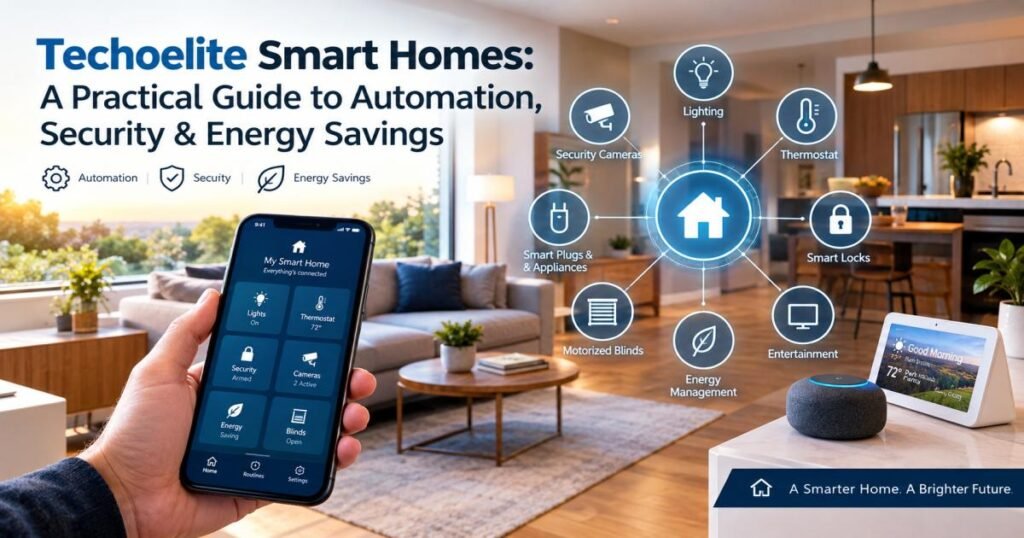
Techoelite Smart Homes: A Practical Guide to Automation, Security & Energy Savings
Techoelite smart homes are connected living spaces where lighting, locks, cameras, thermostats, and appliances work together through automation instead of running as separate gadgets. You set rules once: lock the door at 10 p.m., dim the lights at sunset, drop the temperature when nobody’s home, and the system carries them out on its own. That’s the short answer to what a techoelite smart home actually is. The rest of this guide walks through how the pieces actually fit together, what they cost, and how to build one without wasting money on gear you don’t need.
A smart light bulb by itself is a novelty. A smart lock by itself is a convenience. But when a motion sensor tells the thermostat someone just walked in, and the thermostat tells the lights to turn on, and the whole thing quietly checks that the door is locked at bedtime, that’s when a house starts working for you instead of the other way around.
This guide covers automation, security, energy savings, real costs, ecosystem compatibility, and a step-by-step setup plan. It’s built for renters and homeowners alike, whether you’re starting with one smart plug or planning to wire an entire house.
What Are Techoelite Smart Homes?
A Techoelite smart home is a house where connected devices lights, locks, thermostats, cameras, plugs, and speakers talk to each other and can be controlled from one app, one voice assistant, or one set of automatic rules. The goal isn’t to fill a house with gadgets. It’s to remove small daily chores and reduce the chances that something gets left on, unlocked, or unmonitored.
So what makes a house “smart” instead of just full of connected gadgets? Three things separate a true smart home from a house that just happens to own a smart speaker:
- Central control. One app or hub manages most devices, instead of five separate apps that don’t talk to each other.
- Automation. Actions happen based on triggers: time of day, motion, a sensor reading, without you tapping anything.
- Remote access. You can check, lock, adjust, or view your home from anywhere with an internet connection.
Miss any of these three, and you just have a pile of disconnected gadgets, which is the most common mistake people make when they start.
How Do Techoelite Smart Homes Work?
How does a smart home actually function day-to-day? At a basic level, connected devices sense something, send that information somewhere, and something else acts on it. Here’s how each piece fits.
Sensors and Smart Devices
Sensors are the eyes and ears of the system. Motion sensors detect movement. Door and window sensors detect when something opens. Temperature and humidity sensors track conditions in a room. Water leak sensors catch a burst pipe before it floods a floor. Each one feeds data into the system, and that data is what triggers automation.
Smart Hubs and Controllers
A hub is the translator that lets devices on different wireless standards talk to each other. Not every device needs one; many modern gadgets connect straight to Wi-Fi, but a hub becomes valuable once you own more than a handful of devices, especially ones using Zigbee or Z-Wave rather than Wi-Fi. Popular hub options include Samsung SmartThings, Home Assistant, and Amazon’s Echo devices with a built-in hub.
Wi-Fi, Thread, Zigbee, Z-Wave, and Matter
This is the part that confuses most first-time buyers, so here’s the plain version:
- Wi-Fi connects directly to your router. Simple, but it can crowd your network if you add dozens of devices.
- Zigbee and Z-Wave are low-power mesh networks built for smart homes. They need a hub but use less power and handle more devices without slowing down.
- Thread is a newer low-power mesh network, often paired with Matter, built for battery-powered devices like sensors and locks.
- Matter is not a radio protocol; it’s an application-layer standard that lets certified devices work across ecosystems like Apple Home, Google Home, Amazon Alexa, and Samsung SmartThings without needing a separate app for each brand. As of mid-2026, Matter 1.6 is the current released specification, and the standard has been steadily adding support for cameras, thermostats, and energy devices.
The practical takeaway: look for the Matter logo when buying new devices. It’s the closest thing the industry has to a universal language, and it means you’re not locked into one brand forever.
Cloud-Based vs. Local Smart-Home Control
Cloud-based devices send data to a manufacturer’s servers and need internet access to work; if your internet goes down, so does the automation. Local control means the device and hub talk directly on your home network, so many core functions keep working even without internet. Many Matter-certified devices support local control, which is a real advantage over older cloud-only smart plugs and switches that become useless the moment your Wi-Fi drops.
Apps, Voice Assistants, and Touchscreen Controls
Most people control their smart home three ways: a phone app for detailed settings, a voice assistant (Alexa, Google Assistant, or Siri) for quick commands, and sometimes a wall-mounted touchscreen for shared spaces like a kitchen. None of these replace the others; they’re just different doors into the same system.
Core Features of Techoelite Smart Homes
Smart Lighting
Smart bulbs, switches, and dimmers let you control brightness, color, and timing from an app or by voice. Set lights to turn on at sunset, dim automatically during a movie, or shut off completely when a room sits empty for ten minutes. Beyond convenience, this cuts down on wasted electricity from lights left on in empty rooms a small habit that adds up over a year.
Smart Thermostats and Climate Control
A smart thermostat learns your schedule and adjusts heating and cooling automatically, instead of running full blast while you’re at work. Does a smart thermostat really save money, or is that just marketing? ENERGY STAR-certified smart thermostats can save homeowners an estimated $50 to $145 per year on heating and cooling costs, a figure worth keeping in mind, since it shows up again when we look at total household savings later in this guide. That’s not a huge number on its own, but paired with smart lighting and standby-power management, it adds up over several years.
Smart Locks and Door Access
Smart locks let you lock or unlock doors remotely, set temporary codes for guests or contractors, and get an alert the moment someone enters. Some models auto-lock a set number of minutes after the door closes, which fixes the common problem of forgetting to lock up at night.
Security Cameras and Video Doorbells
Cameras and video doorbells let you see who’s at the door or monitor your property from your phone, whether you’re upstairs or across the country. Combined with motion detection, they can send alerts the instant someone approaches, turning a passive camera into an active early-warning system.
Smart Plugs and Appliances
Smart plugs turn ordinary lamps, fans, and small appliances into automatable devices without replacing the hardware itself. Full smart appliances, such as refrigerators that track groceries and dishwashers that run on off-peak electricity schedules, go a step further, cutting both time spent on chores and, in the case of scheduled appliances, energy costs during high-demand hours.
Motorized Shades and Blinds
Automated shades open with the sunrise and close at sunset, which does double duty: less manual effort and better temperature regulation, since blocking direct sunlight in summer reduces how hard your air conditioning has to work.
Entertainment and Whole-Home Audio
Multi-room audio and connected TVs and speakers mean one playlist can follow you from kitchen to living room, and a single voice command can dim the lights, close the blinds, and start a movie together.
Smart Home Automation: What Can You Actually Automate?
What separates automation from just remote control? Automation is the difference between a smart home and a house full of remote-controlled gadgets. A rule-based automation follows an “if this, then that” structure: if a sensor detects something, then a device responds no tapping required.
Practical Automation Examples
- Morning routine: Blinds open, thermostat adjusts, and the coffee maker starts, all triggered by your alarm going off.
- Away mode: Leaving your home’s geofence locks the doors, turns off lights, and sets the thermostat to an energy-saving temperature.
- Night mode: A single voice command or scheduled time locks doors, dims lights, and arms security cameras.
- Leak protection: A water sensor under the sink automatically shuts off the main water valve if it detects moisture.
- Guest access: A temporary door code is created for a house sitter or contractor and expires automatically after their visit.
Start with two or three automations that solve a real daily annoyance. Trying to automate everything on day one is the fastest way to end up with routines you don’t trust and eventually stop using.
Techoelite Smart Homes for Home Security
Is a smart home actually more secure than a traditional alarm system? Security is consistently the top reason people buy their first smart home device, ahead of energy savings or convenience. A connected security setup typically combines motion sensors, door and window sensors, smart locks, and cameras, all reporting to one app so you get a single alert instead of five separate ones.
The advantage over a traditional alarm system is flexibility. You can check a live camera feed before opening the door, get an alert if a window opens while you’re at work, and grant a delivery driver one-time access without leaving a spare key under the mat.
How to Build a More Secure Smart Home
- Use a dedicated Wi-Fi network for smart devices, separate from the one your laptops and phones use.
- Change default passwords on every device and hub; this is the single most common way smart homes get compromised.
- Turn on two-factor authentication for any app tied to cameras or locks.
- Keep firmware updated. Manufacturers patch security holes regularly, but only if you install the updates.
- Review device permissions periodically and remove access for old guest codes, former house sitters, or apps you no longer use.
Security researchers who track household IoT traffic report tens of automated scan and login attempts per household per day across connected devices, mostly bots probing for weak passwords, not targeted attacks. That number sounds alarming, but it mainly reflects background internet noise, not a house being personally targeted. Basic password hygiene and firmware updates handle the overwhelming majority of real risk.
How Techoelite Smart Homes Can Save Energy and Money
How much can a smart home actually save on utility bills? Energy efficiency is the second most common reason people adopt smart home technology, right behind security. The savings come from a few consistent sources:
- Smart thermostats avoid heating or cooling an empty house, typically saving $50–$145 per year per household, the same range noted earlier for ENERGY STAR-certified models.
- Smart lighting cuts “phantom” waste from lights left on in unoccupied rooms.
- Smart plugs eliminate standby power draw from electronics left plugged in and idle.
- Scheduled appliances run dishwashers and washing machines during off-peak electricity hours where utility rates are lower.
The biggest savings typically come from running these devices together as a coordinated system rather than as isolated purchases. A smart thermostat alone gets you toward that $50–$145 range, but a thermostat that also knows the blinds just closed, and nobody’s home, tends to land at the higher end of it. Individually, none of these savings feel dramatic. Together, over a full year, they routinely offset a meaningful chunk of a household’s utility bill.
Techoelite Smart Homes and Privacy
Does a smart home mean giving up your privacy? Every camera, microphone, and sensor in a smart home collects some form of data, and that data usually passes through a manufacturer’s servers at some point. This isn’t a reason to avoid smart home tech, but it’s worth understanding what you’re agreeing to before a device goes in your living room or front porch.
Practical privacy steps:
- Read the privacy policy for any device with a camera or microphone before buying, specifically what data is stored and for how long.
- Turn off cloud recording for cameras you don’t need archived footage from; many support local storage instead.
- Disable microphones on devices you don’t use for voice control.
- Choose devices with local control options when privacy matters more than convenience, since local devices don’t need to send data off-site to function.
Also Read: ThriftyEvents.net Page: What It Is & Is It Legit in 2026?
Choosing the Right Smart-Home Ecosystem
Which smart home ecosystem is the right fit for your household? Most smart homes end up centered on one of four major platforms. None is universally “best”; the right one depends on the phone you already use and which features matter most to you.
Amazon Alexa
Alexa has the widest device compatibility of any ecosystem and works well for households that want the most product choice at every price point. Echo speakers double as hubs for many Zigbee devices.
Google Home
Google Home integrates tightly with Android phones, Google Assistant, and Nest devices, and tends to have the most natural voice command experience for everyday questions alongside home control.
Apple Home
Apple Home is the most privacy-focused of the major ecosystems, processing more automation locally on-device, and works best for households already deep in iPhones, iPads, and HomePods.
Samsung SmartThings
SmartThings is popular with people who want one hub to bridge many protocols. Zigbee, Z-Wave, and Wi-Fi devices can all report into a single SmartThings setup, making it a strong pick for mixed-brand households.
Whichever you choose, prioritize devices with the Matter logo. It won’t make ecosystem choice irrelevant, but it does mean you’re not permanently stuck if you switch phones or hubs later.
How to Build a Techoelite Smart Home Step by Step
Step 1 — Identify Your Real Problems
Before buying anything, list the actual daily annoyances you want solved: forgetting to lock the door, wasting energy on an empty house, not knowing who’s at the front door. Buying gadgets before identifying the problem is the most common way people overspend.
Step 2 — Create a Smart-Home Plan
Sketch out which rooms and functions matter most: security, lighting, climate, or entertainment. A plan keeps you from buying devices at random that don’t work together later.
Step 3 — Choose Your Main Ecosystem
Pick Alexa, Google Home, Apple Home, or SmartThings based on your phone and priorities, and try to buy devices that work well within it going forward.
Step 4 — Check Device Compatibility
Before buying any device, confirm it works with your chosen ecosystem or supports Matter. This single check prevents the most common beginner mistake: buying a device, then discovering it doesn’t integrate with anything else you own.
Step 5 — Start With High-Impact Devices
Begin with a smart thermostat, a video doorbell, or a smart lock the devices that solve the biggest problems from Step 1, rather than the cheapest or flashiest gadget available.
Step 6 — Secure Your Network and Accounts
Set up a separate Wi-Fi network for smart devices, use strong unique passwords, and enable two-factor authentication before adding more devices.
Step 7 — Create Simple Automations
Build two or three automations that solve real daily friction: an away mode, a bedtime routine, a morning routine, rather than trying to automate the entire house immediately.
Step 8 — Test Every Routine and Manual Override
Confirm every automation works as expected, and make sure you can always manually override a lock, light, or thermostat if the automation fails or the internet goes down.
Step 9 — Monitor Energy Use and Reliability
Most smart thermostats and energy monitors show usage data in-app. Check it after a month to see whether your automations are actually saving energy, and adjust schedules that aren’t pulling their weight.
Step 10 — Expand Gradually
Add new devices one category at a time lighting, then security, then entertainment testing each addition before layering on the next. Gradual builds are more reliable and easier to troubleshoot than an all-at-once installation.
How Much Does a Techoelite Smart Home Cost?
What should you actually budget for a smart home setup? Costs scale enormously depending on how far you go:
- Starter setup (a few smart plugs, one smart speaker, a couple of bulbs): roughly $50–$150.
- Mid-range setup (smart thermostat, video doorbell, a handful of locks and sensors): roughly $400–$900.
- Whole-home automation (full lighting, security, climate, and entertainment integration, professionally installed): $2,000 and up, depending on home size and whether wiring work is needed.
There’s no requirement to jump straight to whole-home automation. Most smart homes are built gradually over months or years, one high-impact device at a time, which also spreads the cost out and lets you learn what you actually use before spending more.
Techoelite Smart Homes for Renters vs. Homeowners
Best Options for Renters
Renters should stick to devices that don’t require permanent installation or wiring changes: plug-in smart outlets, battery-powered sensors, portable cameras, and lock covers that fit over an existing deadbolt without replacing it. Nearly everything in this category can be removed and taken with you at move-out.
Best Options for Homeowners
Homeowners have more flexibility for hardwired devices, in-wall smart switches, wired video doorbells, and full smart lock replacements, which tend to be more reliable long-term than battery-powered or plug-in alternatives.
Retrofitting an Older Home
Older homes without neutral wires in every switch box can complicate hardwired smart switch installation. Battery-powered smart switches or Wi-Fi smart bulbs sidestep this issue entirely, letting you automate lighting without an electrician needing to run new wiring.
Common Techoelite Smart Home Mistakes to Avoid
- Buying devices across incompatible ecosystems without checking Matter or hub support first.
- Skipping password changes on new devices, leaving default logins in place.
- Automating everything at once, which makes it hard to identify which rule is causing a problem.
- Ignoring firmware updates, which is one of the most common ways smart devices become vulnerable.
- Relying entirely on cloud control with no manual override, leaving you locked out if internet service drops.
- Overspending on entertainment features first instead of starting with security or energy-saving devices that solve real daily problems.
Pros and Cons of Techoelite Smart Homes
Advantages
- Centralized control of lighting, locks, climate, and entertainment from one app or voice assistant
- Real, measurable energy savings from smart thermostats and lighting schedules
- Stronger home security through remote monitoring and instant alerts
- Convenience features like temporary guest access and automated routines
- Growing cross-brand compatibility through the Matter standard
Disadvantages
- Upfront cost, especially for whole-home automation
- Dependence on Wi-Fi and, for cloud-based devices, internet access
- Ongoing privacy considerations with cameras and microphones
- A learning curve when setting up automations correctly
- Potential compatibility headaches when mixing ecosystems without checking Matter support
Are Techoelite Smart Homes Worth It?
Is a Techoelite smart home actually worth the investment, or is it a passing trend? For most households, yes, but the value depends on which devices you choose. A smart thermostat and a couple of well-placed cameras deliver real, measurable benefit for a modest cost, often paying part of themselves back through the $50–$145 in yearly thermostat savings alone. A house wired top to bottom with every available gadget is a bigger investment that pays off mainly for people who genuinely use and maintain that much automation. Start small, solve real problems first, and expand only when you’re confident the current setup is actually saving you time, money, or peace of mind.
The Future of Techoelite Smart Homes
The next few years point toward tighter cross-brand compatibility through Matter, deeper integration with home energy systems like solar panels and EV chargers, and smarter automation that adapts to household patterns without manual rule-setting. Industry forecasts put the global smart home device market on a path toward roughly $225–$334 billion by the end of the decade, driven largely by energy management, expanding device categories under Matter, and rising demand in markets outside North America and Western Europe. The direction is clear: less fragmentation between brands, and more homes that manage themselves quietly in the background.
Final Verdict
Techoelite smart homes work best when you treat them as a gradual project, not a one-time purchase. Start with the problem you actually want solved security, energy waste, or daily convenience pick an ecosystem that fits your phone and household, and build outward from there, one tested device at a time. Done this way, a smart home doesn’t just add gadgets to a house. It quietly removes friction from daily life, tightens up security, and pays part of itself back in lower energy bills along the way.
FAQs
What are Techoelite smart homes?
Techoelite smart homes are connected living spaces where lighting, security, climate control, and appliances are linked together and can be automated or controlled remotely from a single app or voice assistant.
Are Techoelite smart homes a specific brand?
No. The term describes a category of connected home technology rather than one manufacturer’s product line. It covers the broader approach of linking smart devices lighting, security, climate, and entertainment into one automated system, regardless of which brands you use.
How much does a techoelite smart home cost?
Costs range from about $50 for a starter kit of smart plugs and a speaker, up to several thousand dollars for a professionally installed whole-home system. Most people build up gradually rather than spending everything at once.
Do I need a smart-home hub?
Not always. Many modern devices connect directly to Wi-Fi. A hub becomes useful once you own several Zigbee or Z-Wave devices, since it lets them communicate without each needing its own app.
Can techoelite smart homes reduce energy bills?
Yes. Smart thermostats alone typically save $50–$145 per year, and combining them with smart lighting and scheduled appliances increases the total savings over a full year.
Are smart homes safe from hackers?
They can be, if set up correctly. Most real-world risk comes from default passwords and outdated firmware, not sophisticated targeted attacks. Changing default logins, enabling two-factor authentication, and keeping devices updated address the large majority of security risk.
What should I automate first?
Start with whichever daily task causes the most friction: a bedtime routine that locks doors and turns off lights, or an away mode that adjusts the thermostat when you leave. Small, reliable automations are more valuable than a dozen half-tested ones.






2 Comments