
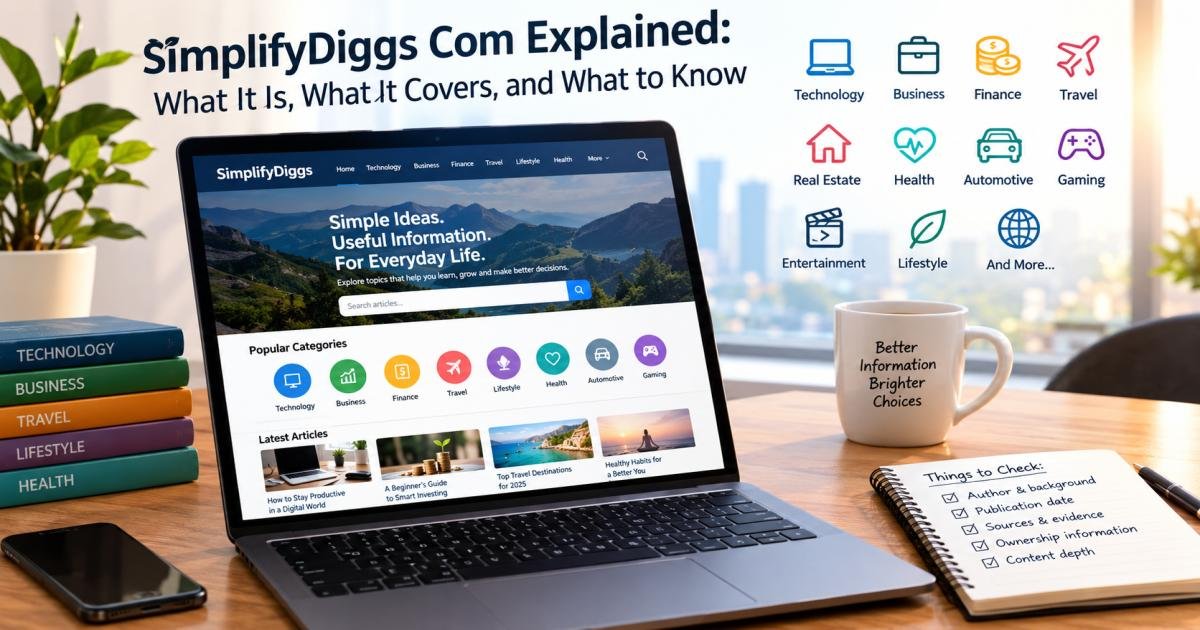
SimplifyDiggs Com Explained: What It Is, What It Covers, and What to Know
SimplifyDiggs. com is a general-interest blog that publishes short, plain-worded articles on many topics. One review describes guides, explainers, and quick tips on technology, home, learning, and lifestyle, with nothing for sale and no account to create. Other reviews add business, finance, travel, gaming, and cars.
Here is the catch. The site is easy to read, hard to verify. You can finish an article in three minutes. Finding out who wrote it, and why you should believe it, takes much longer.
How this guide was built: We read independent reviews of the site from 2026, compared how different pages describe it, and marked every point where they disagree. We could not confirm an owner, so we do not name one. Where no public proof exists, we say so. Last reviewed: October 2026.
Quick Facts About SimplifyDiggs Com
| Question | Short answer |
| What is it? | A multi-topic blog with general articles |
| Does it sell anything? | Not according to the reviews we found |
| Do you need an account? | No, per the same reviews |
| Who runs it? | Not clearly stated in public sources |
| Who writes the articles? | Unclear; guest posts appear to be part of the mix |
| Good for deep research? | No. Use it as a starting point |
| Risky to read? | Low risk for reading; use normal care with links and pop-ups |
What Simplifydiggs com Actually Publishes
One reviewer says the site looks like a full online magazine at first glance, with many subjects, a clean blog style, and plenty of categories. The same reviewer adds that it feels more like a content frame still finding its shape than a finished publication.
The topic list is wide. Across reviews, these areas come up most:
- Technology and software
- Business and startups
- Finance and money tips
- Lifestyle and home
- Travel
- Gaming and entertainment
- Health and wellness
- Cars and general how-to guides
Not every page agrees. One write-up calls the site a lifestyle “web-based application.” Most others call it a blog. When two descriptions clash, trust the simpler one. A site with no product and no login is a blog, not an app.
What does a visitor actually get? Mostly short explainers. A title asks a plain question. Headings and short paragraphs answer it. That format works well for someone who wants a fast overview.
It works poorly for someone who wants proof. Topics this wide rarely come from one team of experts. That leads to the next question: how the articles get made.
How SimplifyDiggs com Content Is Made
Nobody outside the site knows for sure. We found no public page that explains the process. We saw no editorial policy, no list of editors, and no note on how facts get checked.
What we can say comes from patterns in the reviews.
The writing is plain and general. One reviewer finds the text simple and easy to follow, and says the articles are not always badly written, but useful rather than memorable.
Guest posts appear to be part of the model. The same reviewer says promotional wording in some guest posts suggests the site was partly built to place content. Another review notes that third-party marketplaces advertise guest-post and backlink placements on the SimplifyDiggs.com domain, though that alone does not show how each page was commissioned or edited.
Put those facts together and a likely picture forms. Some articles may come from in-house writers. Others may come from outside contributors who want a link to their own site. A reader can’t tell which is which.
Blogs like this typically work one of three ways:
- One small team writes everything. Quality stays steady, but coverage stays narrow.
- Staff and outside writers share the load. Quality varies by page.
- Most posts are sponsored or contributed. Topics follow whatever clients pay to promote.
The reviews hint that SimplifyDiggs com sits between the second and third types. We can’t confirm that. So judge each article on its own evidence, not on the site’s name.
Who owns SimplifyDiggs com?
We could not find a clear public answer.
That alone is not a bad sign. Small blogs typically run under personal names, private accounts, or small companies that never appear on the page. But it matters for trust. One reviewer notes that the site does not show enough basic identity information.
You can check this yourself in about ten minutes.
Step 1: Read the About, Contact, and Privacy pages.
A real publisher usually lists a name, an email, or a company. Vague wording, or no such pages, is a signal.
Step 2: Run a domain lookup.
The free ICANN lookup at lookup.icann.org shows when a domain was registered and with which company. Many owners hide personal details behind a privacy service, so a blank owner field is common. The registration date is more useful. A site that claims years of experience but was registered recently deserves a second look.
Step 3: Check the site’s past.
The Internet Archive’s Wayback Machine at archive.org stores old versions of pages. If the site once covered a very different subject, you learn something about how it grew.
Step 4: Search the author names.
An author with no profile, no other work, and no history is a label, not a credential.
Step 5: Watch for look-alike domains.
Search results show several sites with similar names and different domain endings, and a similar name does not prove a shared owner, team, or policy. Always read the exact address in your browser bar.
Until the site says more about itself, “owner unknown” is the accurate answer.
Easy Reading, Thin Substance
This point divides opinion on SimplifyDiggs com, and it is the core of the matter.
Start with the good news. Plain language is hard to write well. Short words, short sentences, clear headings. A beginner can follow every line. That is a real strength.
Now the catch. Easy reading and deep knowledge are different things. An article can sound clear and still be wrong, old, or empty. Easy to read, hard to verify.
Think of a travel guide written by someone who never took the trip. The directions read well. You only find the gaps when you try to follow them.
Reviewers raise the same worry. They point to the site’s broad focus, light author details, limited subject expertise, and the shallow depth of some articles. These notes do not say every page is wrong. They say you can’t assume a page is right because it looks tidy.
Thin substance on a general blog usually shows up like this:
- No source. A claim about law, money, or health with no link to where it came from.
- No date. You can’t tell if the advice is from last month or six years ago.
- No test. A “review” that never says how the product was used.
- No limits. The article never says what it leaves out.
- Familiar wording. Headings and phrases that match dozens of other pages on the same subject.
If you spot two or three of these in one article, pause. The piece may be fine for a quick look. It isn’t enough to base a decision on.

SimplifyDiggs com: Strengths
A fair review should name what works.
Simple to use. Reviews report no sales and no sign-up. You open a page and read.
Clean layout. Reviewers describe a tidy blog design with many categories, which makes browsing easy.
Plain language. This is the biggest plus. A reader with no background can follow an article from top to bottom.
Many topics in one place. If you like to jump from a tech explainer to a travel tip, one multi-topic blog saves a few searches.
Low risk to read. With no checkout and no login, a visitor has less to get wrong.
A decent first look. If you’ve never met a term, a plain explainer can give you the basic idea in minutes.
Notice what these strengths share. They are about convenience and readability. None proves accuracy. That isn’t a knock on the site. It’s what a general blog does well.
SimplifyDiggs com: Weaknesses and Red Flags
These are the points to know before you rely on any page.
1. Very wide topic range.
Writing about cars, finance, health, gaming, and software on one site takes many kinds of expertise. Reviewers say readers should look for proof of it, not assume it.
2. Unclear authorship.
A byline with no background can’t tell you whether the writer knows the topic.
3. Guest-post signals.
Marketplace listings advertise paid placements on the domain. Paid posts aren’t always bad, but they should carry a label. For reference, Google’s guidance says paid links should use a “sponsored” tag. Unlabeled paid links can break Google’s link rules.
4. Promotional wording.
If a post praises one company with no tests, prices, or comparisons, read it as an ad.
5. No visible owner, policy, or corrections page.
Without them, nobody is clearly accountable for mistakes.
6. Conflicting descriptions across the web.
Many pages that rank for this name share near-identical headings and vague claims. Some call the site a lifestyle platform, others a blog. When the outside noise is this messy, rely on what you can see yourself.
7. Look-alike domains.
Similar names on other endings can make a search result look more official than it is.
| Warning sign | Why it matters |
| No author bio | You can’t judge expertise |
| No publish or update date | Advice may be out of date |
| No sources | Claims can’t be checked |
| Heavy praise for one brand | May be a paid post |
| Downloads or sign-ups | Raises the risk level |
| Unexpected domain ending | May be a copycat |
None of these means “scam.” Each one means “check more.”
Where Simplifydiggs com Holds Up, and What Would Fix It
The site has a usable base. The writing is clear. The layout is clean. The topic spread already exists. What’s missing is proof of who stands behind the words.
These changes would move it from readable to reliable:
- Real author pages. A short bio for each writer, with background and links to other work.
- A written editorial policy. Three short paragraphs on how articles are researched, checked, and corrected.
- Clear labels on paid content. Mark sponsored and contributed posts at the top.
- Sources inside articles. Link the government page, study, or official document behind each key claim.
- Visible dates. Show when each piece was published and last updated.
- A real About page. Name the owner or company and give a working contact route.
- Deeper categories. Keep the wide range, but build a few categories with named experts instead of spreading thin.
- Original material. Screenshots, tests, and first-hand notes give readers what ten similar pages can’t.
Most small publishers can do this in a few weeks, typically. The payoff is trust. A reader who sees these signals can believe the content faster. Right now, the site asks for belief and offers little to check.
Who Is SimplifyDiggs com For?
It fits you if you are:
- A casual reader who likes browsing many topics
- A student or beginner who wants a plain first look at a subject
- Someone who needs a quick definition or simple how-to
- A reader who treats each article as a lead, then checks elsewhere
It does not fit you if you are:
- Making a medical, legal, tax, or money decision
- Writing a school paper or news story that needs strong sources
- Looking for expert product tests with real data
- Hoping to find a service, clinic, or company behind the name
A note for writers and marketers: If you plan to buy a guest post, review the posts already there first. Check whether they draw real readers and whether paid links get labeled. A link on a weak page typically brings little value.
Can you trust Simplifydiggs com for research?
Short answer: Use it to start, not to finish. Easy to read, hard to verify means every important claim needs a second look.
Use this five-step method on any unfamiliar blog:
- Read for the big idea. What is the article saying?
- List the claims that matter. Prices, dates, rules, health facts, anything you’d act on.
- Find the source. For taxes, check IRS.gov. For health, check CDC.gov. For investments, check SEC.gov. For software, check the maker’s own page.
- Check the date. Rules and prices change often.
- Compare two other sources. If three agree, relax. If one stands alone, be careful.
| Your goal | Is SimplifyDiggs com enough? | Better source |
| Learn what a term means | Fine as a first look | A dictionary or official glossary |
| Understand a tech trend | A starting point | The company’s own documentation |
| Check a tax or legal rule | No | Government websites |
| Decide on a health step | No | A doctor or public health site |
| Compare products | Weak | Independent lab or user tests |
| Cite in an essay | No | Books, journals, primary sources |
The higher the stakes, the stronger the source you need.
Is SimplifyDiggs com safe?
Two questions hide inside this one. Is the site risky to open? And is its advice safe to follow? They have different answers.
Is it risky to open? Based on the reviews, the risk looks low for plain reading. They describe a site that sells nothing and asks for no account. That removes the two biggest danger points: payments and passwords.
Any unfamiliar site still calls for normal care:
- Check the address. Make sure it reads simplifydiggs.com, not a near-match.
- Skip unexpected downloads. An article never needs you to install anything.
- Decline notification pop-ups. If the browser asks to send alerts, say no.
- Keep personal data to yourself unless there’s a clear reason to share it.
- Hover before you click. Check where an outside link goes.
- Keep your browser updated and never reuse passwords.
Is the advice safe to follow? That depends on the article. A page can be harmless to open and still be wrong. For a recipe idea or travel list, small errors cost little. For health, law, or money, wrong advice can cost a lot. Verify first.
What Is Brasssmile Com Website?
Brasssmile com shows the same problem in another form: a name the web describes in very different ways.
From the name alone, you’d guess a dental clinic. Some pages say exactly that. One calls it a customized dental service meant to give a natural, confident smile. Another calls it an online platform for dental care and smile enhancement.
Then there is the opposite view. One audit says that what loads at brasssmile com is a general blog on gadgets, business, and everyday living, with no dental service behind it, and that “smile” is branding, not a health promise.
These descriptions can’t all be true of one site. In the pages we saw, none named a licensed dentist or a clinic address. When write-ups disagree this much, be careful.
What this means for you:
- Don’t let a name tell you what a site does. “Smile” in a domain doesn’t make it a dental site.
- Don’t book or pay based on a vague write-up.
- For dental care, use a licensed dentist. Check your state or national dental board.
- Check the exact domain. The same audit warns about look-alike addresses.
We found nothing that ties Brasssmile com to SimplifyDiggs com. It appears here as a second example of how to read a confusing website name: slowly, with a checklist.
Conclusion
SimplifyDiggs com is a broad, plain-spoken blog. It covers many topics, asks nothing of the reader, and is easy to follow. Those are real strengths.
It also shows little about itself. No clear owner. Thin author details. Signs of guest posts. Reviewers raise the same worries about focus and depth, and many other pages describe the site in vague, sometimes conflicting ways.
The fair verdict is mixed. Treat it as casual reading and a source of ideas. Do not treat it as an authority. Easy to read, hard to verify: that is the whole story.
Keep three things in mind:
- Judge each article on its own, not on the site’s name.
- Check the author, date, and sources every time.
- Confirm anything important with an official or expert source.
FAQs
What is simplifydiggs com?
SimplifyDiggs com is a general-interest blog that publishes short, plain-worded articles on many subjects, including technology, business, lifestyle, travel, and gaming. Public reviews describe it as a content site, not a store or app.
Is simplifydiggs com legit?
One review says it does appear to be a real, indexed publishing site. “Real” is not the same as “authoritative.” Reviews raise questions about author details and depth, so check each article.
Is simplifydiggs com safe to visit?
Reading a public article looks low risk. Reviews report no sales and no sign-up. Still, check the exact domain, skip downloads, and decline pop-up alerts.
Who owns simplifydiggs com?
No clear owner appears in public sources we reviewed. A domain lookup at lookup.icann.org may show the registration date and registrar, though many owners hide personal details.
Does simplifydiggs com accept guest posts?
Marketplace listings advertise guest-post and backlink placements on the domain. We found no confirmed policy on the site itself. Contact the site directly before you pay anyone.
Is simplifydiggs com reliable for research?
Only as a starting point. Verify any health, legal, tax, or money claim with an official or expert source.
What does simplifydiggs com cover?
Reviews list technology, business, finance, lifestyle, travel, gaming, health, home,e and cars. Coverage is broad, not deep.
Are other SimplifyDiggs domains the same website?
Not necessarily. Similar names on other domain endings can belong to different owners. Always check the full address.



One Comment